





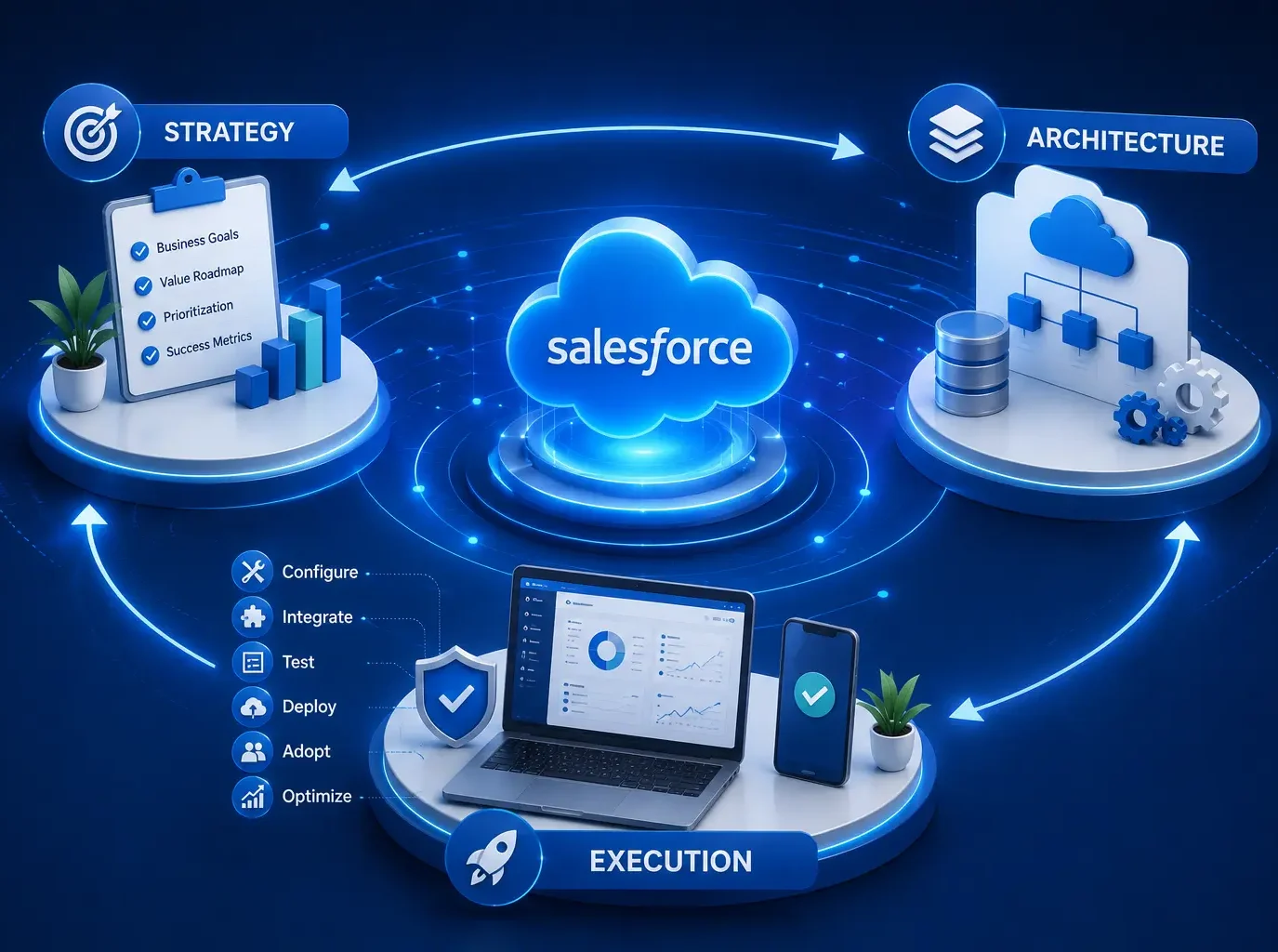

New to Salesforce
Organizations moving from spreadsheets or manual systems require a properly designed architecture, clean data structure, and scalable automation from the beginning.

Migrating from Another CRM
Transitioning from a legacy CRM requires secure data migration, process redesign, and system alignment without disrupting revenue operations or day-to-day business activities.

Underperforming Salesforce
Low user adoption, inconsistent reporting, manual workarounds, or poorly designed automation signal foundational gaps that require optimization and long-term platform improvements.

Scaling Revenue Teams
Growing sales and service teams require structured pipelines, performance tracking, forecasting capabilities, and scalable processes built to support increasing business demand.

Multi-Region Governance Requirements
Operating across locations or business units requires role hierarchy, data visibility control, and standardized operational processes.

Complex Integration Needs
Integrating Salesforce with ERP, finance, marketing platforms, or custom enterprise systems requires architectural precision, seamless connectivity, and long-term scalability planning.

Increased Lead Conversion
Clearly defined pipelines, automated follow-ups, and standardized qualification processes ensure fewer leads are lost while more opportunities move forward with purpose. Improved visibility into lead sources and performance enables smarter marketing and sales alignment.
Improved Forecasting Accuracy
Structured data models and disciplined reporting eliminate guesswork. Leadership gains reliable revenue projections backed by real-time performance data. Accurate forecasting supports better budgeting, hiring decisions, and strategic planning.
Reduced Sales Cycle
Automation replaces repetitive tasks, reminders keep deals progressing, and centralized communication reduces delays, enabling faster movement from lead to close. Shorter sales cycles directly improve revenue velocity and overall team productivity.
Higher Customer Retention
A unified customer view allows teams to understand history, preferences, and interactions, resulting in more personalized engagement and stronger long-term relationships. Consistent service delivery increases trust and reduces churn over time.
Workflow Automation
Manual coordination is replaced with rule-based processes that trigger actions automatically, reducing errors and freeing teams to focus on high-value activities. Standardized automation also ensures process consistency across teams and regions.
Executive Visibility
Interactive dashboards provide immediate insight into pipeline health, team performance, and revenue trends, empowering informed decision-making at every level. Leaders gain clarity without relying on manual reports or fragmented data sources.
Operational Efficiency
Integrated systems remove data silos, streamline collaboration across departments, and create a scalable foundation for growth. As complexity increases, structured systems prevent operational bottlenecks.

Manufacturing
Manufacturing
Optimizing production visibility, distributor networks, and multi-stage sales operations through structured CRM ecosystems.

Hi-Tech
Hi-Tech
Enabling subscription visibility, product lifecycle management, and revenue operations for fast-scaling technology companies.

Construction
Construction
Streamlining project pipelines, asset management, contract workflows, and commission tracking with scalable CRM architecture.

Real Estate
Real Estate
Simplify property management, lead tracking, client relationships, and deal closures with a connected Salesforce ecosystem for buyers, sellers, and agents.

Logistics & Transportation
Logistics & Transportation
Optimize shipment visibility, fleet coordination, partner collaboration, and customer communication with a connected Salesforce ecosystem.

Healthcare
Healthcare
Supporting patient engagement, compliance-driven workflows, and cross-department coordination with secure CRM solutions.

Travel and Tourism
Travel and Tourism
Enhancing customer journey management, booking visibility, and service personalization across distributed operations.

Telecommunications
Telecommunications
Managing complex service operations, subscription models, and customer engagement across multi-channel environments.

Non-Profit Organizations
Non-Profit Organizations
Streamlining fundraising, donor engagement, grant tracking, and program management with connected Salesforce ecosystems.

Legal
Legal
Improving case tracking, client communication, and operational oversight with centralized CRM platforms.

Revenue-Operations Focus
Implementation is aligned with measurable outcomes including pipeline visibility, automation efficiency, forecasting accuracy, and executive reporting clarity. Salesforce is positioned as a revenue engine, not just a CRM platform.

71

25
30

4
50
39

2

3
58
5
8
13

8

4

3
3
2
2
1
3
2